AP Physics 1
Score Calculator
⚛️ AP Physics 1 Score Calculator
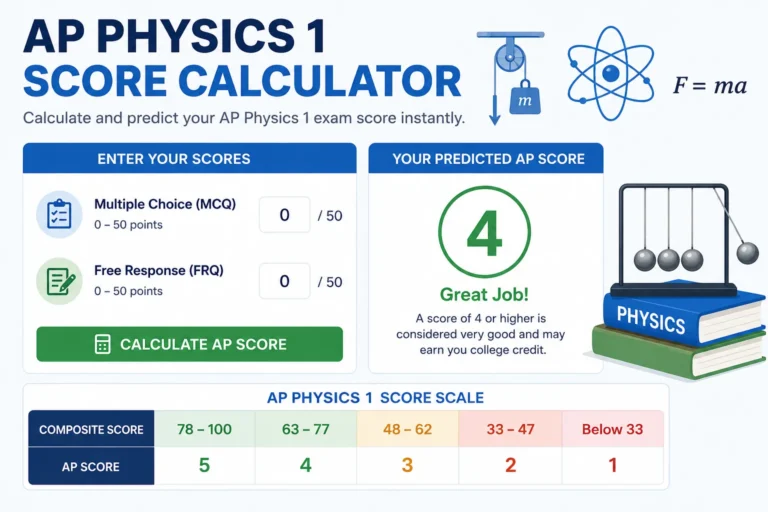
Based on the 2025–26 exam format: 40 MCQs (50%) + 4 FRQs (50%). Enter your raw scores to predict your 1–5 score instantly.
AP Physics 1 Score Calculator 2026 – Predict Your AP Exam Score
Calculate Your AP Physics 1 Exam Score Instantly
Our free AP Physics 1 score calculator helps students estimate their AP Physics exam score using the latest College Board scoring format. Whether you want to calculate your AP Physics composite score, predict your AP exam results, or estimate your AP Physics performance before official scores are released, this AP Physics 1 exam score calculator provides fast and accurate score predictions.
This AP score calculator Physics 1 tool is designed for students preparing for the AP Physics 1 exam and supports scoring for:
- Multiple Choice Questions (MCQs)
- Free Response Questions (FRQs)
Using the updated AP Physics 1 score calculator 2025, students can better understand their expected AP score on the official 1–5 AP grading scale.
What Is the AP Physics 1 Score Calculator?
The AP Physics 1 score calculator is an online AP exam score estimator that predicts your AP Physics exam score based on your performance in different exam sections.
This AP Physics score predictor combines:
- MCQ performance
- FRQ scores
- weighted scoring calculations
- composite score estimation
to estimate your final AP Physics 1 score.
Students often use an AP Physics exam calculator to:
- predict AP exam performance
- estimate AP credits
- understand score conversion
- evaluate practice test performance
- prepare for STEM admissions
The calculator uses unofficial AP score prediction models based on historical College Board scoring trends and AP Physics grading scales.
AP Physics 1 Exam Format Explained
Understanding the AP Physics 1 exam structure is important before using the AP Physics score calculator.
Multiple Choice Questions (MCQs)
The MCQ section evaluates:
- conceptual understanding
- scientific reasoning
- graph interpretation
- force and motion analysis
- vector analysis
- mathematical modeling
Students must apply physics formulas and solve conceptual physics problems accurately.
MCQs make up a significant portion of the AP Physics composite score.
Free Response Questions (FRQs)
The FRQ section tests your ability to:
- solve physics equations
- analyze experimental design
- apply Newton’s Laws
- interpret graphs and data
- explain scientific concepts
- demonstrate quantitative reasoning
Strong FRQ performance can significantly improve your AP Physics 1 exam score.
How to Use the AP Physics 1 Score Calculator
Using this AP Physics score estimator is simple.
Step 1: Enter MCQ Score
Input the number of correct multiple-choice answers.
Step 2: Add FRQ Scores
Enter your total FRQ rubric points.
Step 3: Calculate Composite Score
The calculator combines weighted section scores.
Step 4: Predict AP Physics Score
Click the calculate button to instantly view your estimated AP score.
This AP Physics 1 AP score calculator helps students understand how raw scores convert into scaled AP scores.
How AP Physics 1 Scores Are Calculated
The AP Physics 1 exam uses a weighted scoring model developed by the College Board.
Composite Score=MCQ Score+FRQ Score\text{Composite Score} = \text{MCQ Score} + \text{FRQ Score}Composite Score=MCQ Score+FRQ Score
Your raw score is converted into a scaled AP score ranging from 1 to 5.
The AP score calculator AP Physics 1 estimates this conversion using:
- historical AP score distributions
- AP Physics grading trends
- weighted scoring systems
- exam difficulty analysis
- score scaling adjustments
AP Physics 1 Score Conversion Chart (1–5 Scale)
Below is a general AP Physics score conversion chart.
| Composite Score | Predicted AP Score |
|---|---|
| 78–100 | 5 |
| 63–77 | 4 |
| 48–62 | 3 |
| 33–47 | 2 |
| Below 33 | 1 |
This AP Physics grading scale helps students estimate whether they may earn passing AP scores or qualify for college credit.
AP Physics 1 Score Calculator 2026 Updates
The AP Physics 1 score calculator 2026 reflects the latest AP Physics exam structure and College Board scoring standards.
Recent updates include:
- revised AP Physics exam guidelines
- updated FRQ scoring rubrics
- current AP exam weighting
- improved score prediction models
- updated scientific reasoning standards
Students preparing for the latest AP Physics exam should practice using updated AP Physics scoring rubrics and exam strategies.
What Is a Good AP Physics 1 Score?
A good AP Physics score depends on your academic goals and university requirements.
AP Score 3
A score of 3 is generally considered passing and may qualify for AP credit at many colleges.
AP Score 4
A score of 4 is competitive and demonstrates strong understanding of AP Physics concepts.
AP Score 5
A 5 is considered excellent and represents outstanding mastery of AP Physics material.
High AP Physics scores may help students:
- earn college credits
- strengthen university applications
- improve STEM admissions opportunities
- skip introductory physics courses
Colleges That Accept AP Physics 1 Scores
Many colleges and universities accept AP Physics scores for placement or college credit.
Benefits of strong AP scores include:
- reduced tuition costs
- advanced course placement
- accelerated graduation
- engineering and science program advantages
Because AP credit policies vary, students should always verify official university score requirements.
Important AP Physics 1 Topics for High Scores
Understanding core AP Physics concepts is essential for achieving high AP exam scores.
Kinematics
Focuses on:
- velocity
- acceleration
- displacement
- motion equations
- graph interpretation
Newton’s Laws
Students learn:
- force and motion
- free-body diagrams
- Newton’s Second Law
- net force calculations
Work, Energy, and Power
Covers:
- kinetic energy
- potential energy
- conservation of energy
- work formula
- power equations
Momentum and Collisions
Includes:
- momentum equations
- impulse
- collision analysis
- conservation principles
Rotational Motion
Explores:
- rotational dynamics
- torque
- angular motion
- circular motion
Waves and Sound
Students study:
- wave motion
- sound waves
- frequency
- wavelength
- harmonic motion
Electricity and Circuits
Includes:
- Ohm’s Law
- circuits
- voltage
- resistance
- current analysis
Mastering these AP Physics units can improve both MCQ and FRQ performance.
Important AP Physics 1 Formulas
Understanding AP Physics formulas is essential for solving conceptual and calculation-based questions in the AP Physics 1 exam. Students preparing for the AP Physics test should not only memorize these equations but also understand how to apply them in scientific reasoning, experimental analysis, graph interpretation, and problem-solving scenarios.
These AP Physics equations are commonly tested in both Multiple Choice Questions (MCQs) and Free Response Questions (FRQs). Strong knowledge of these formulas can improve your AP Physics composite score and help you achieve higher AP exam results.
Newton’s Second Law
Newton’s Second Law explains the relationship between force, mass, and acceleration. It is one of the most important concepts in AP Physics 1 and is heavily used in force and motion problems, free-body diagrams, and acceleration calculations.
F=maF = maF=ma
Where:
- F = net force
- m = mass
- a = acceleration
Students use this formula to analyze motion, calculate forces, and solve conceptual physics questions involving dynamics and Newton’s Laws.
Kinetic Energy Formula
The kinetic energy equation calculates the energy possessed by an object because of its motion. This formula is commonly used in work-energy theorem questions and conservation of energy problems.
Where:
- KE = kinetic energy
- m = mass
- v = velocity
Understanding kinetic energy helps students solve AP Physics problems involving motion, energy conservation, collisions, and velocity analysis.
Momentum Formula
Momentum measures the quantity of motion of an object and plays a major role in collision analysis and impulse problems.
Where:
- p = momentum
- m = mass
- v = velocity
Students frequently apply this formula in AP Physics collision scenarios and momentum conservation questions.
Ohm’s Law
Ohm’s Law explains the relationship between voltage, current, and resistance in electrical circuits.
Where:
- V = voltage
- I = current
- R = resistance
Electricity and circuits are important AP Physics 1 topics, especially for conceptual and calculation-based FRQs.
Work Formula
The work formula calculates how much energy is transferred when a force moves an object over a distance.
W=FdW = FdW=Fd
Where:
- W = work
- F = force
- d = displacement
Work-energy problems are common in AP Physics FRQs and conceptual reasoning questions.
AP Physics 1 Problem-Solving Strategies
Success in AP Physics requires strong scientific reasoning and analytical thinking.
Important strategies include:
- analyzing free-body diagrams
- identifying known variables
- applying correct equations
- checking units carefully
- interpreting graphs accurately
- understanding conceptual relationships
These AP Physics problem-solving strategies can significantly improve exam performance.
Tips to Improve Your AP Physics 1 Exam Score
Improving AP Physics exam performance requires strategic preparation.
Practice FRQs Regularly
Focus on:
- equation application
- scientific explanations
- graph analysis
- experimental reasoning
Improve Conceptual Understanding
Students should understand physics concepts instead of memorizing formulas only.
Learn Formula Applications
Practice identifying when and how to apply AP Physics equations.
Solve Practice Tests
Practice exams help students understand:
- AP Physics scoring
- timing strategies
- conceptual question patterns
- composite score estimation
Manage Exam Time Effectively
Good pacing improves both MCQ and FRQ performance during the AP exam.
Practice AP Physics Score Calculations
Below are sample AP Physics score prediction examples.
Example 1
- MCQ Score: 42
- FRQ Score: 18
Predicted AP Score: 4
Example 2
- MCQ Score: 50
- FRQ Score: 24
Predicted AP Score: 5
These examples help students better understand AP Physics composite score calculations.
How Accurate Is the AP Physics 1 Score Calculator?
This AP Physics exam calculator provides unofficial AP score estimates based on historical AP scoring patterns and College Board grading trends.
While the calculator offers useful predictions, official AP results may vary because of:
- yearly score curves
- national performance trends
- exam difficulty variations
- score scaling adjustments
Students should use this AP Physics score estimator as a preparation and performance analysis tool.
AP Physics 1 Score Distribution Trends
AP Physics score distributions can vary each year depending on exam difficulty and national student performance.
Factors affecting score trends include:
- FRQ complexity
- MCQ difficulty
- scoring curve adjustments
- curriculum updates
- national testing performance
Reviewing AP Physics score distribution trends helps students understand competitive score ranges.
Common AP Physics 1 Scoring Mistakes
Many students lose valuable points because of avoidable errors.
Formula Misuse
Applying incorrect equations often leads to calculation errors.
Weak Conceptual Reasoning
Students who memorize formulas without understanding concepts struggle on application questions.
Unit Conversion Errors
Incorrect units can reduce FRQ scoring accuracy.
Poor Time Management
Spending too much time on difficult questions may hurt overall exam performance.
Avoiding these AP Physics scoring mistakes can improve predicted AP scores significantly.
Skills Needed to Score High in AP Physics 1
Students aiming for high AP Physics scores should develop:
- analytical thinking
- quantitative reasoning
- scientific reasoning
- experimental analysis
- graph interpretation
- conceptual problem-solving
- mathematical modeling
These STEM skills are valuable for engineering, science, and technical careers.
Frequently Asked Questions
How is the AP Physics 1 exam scored?
The AP Physics 1 exam score is calculated using weighted MCQ and FRQ scores.
Is the AP Physics 1 score calculator accurate?
Yes, the calculator provides reliable unofficial AP score estimates using historical scoring trends.
What is a passing AP Physics 1 score?
Most colleges consider a score of 3 or higher as passing.
How many points do you need for a 5 in AP Physics 1?
A composite score around 78 or higher often predicts a 5, though yearly scoring curves may vary.
Can I predict my AP Physics score before results day?
Yes, this AP Physics score calculator helps estimate scores before official AP results are released.
Is AP Physics 1 difficult?
AP Physics 1 is considered challenging because it focuses heavily on conceptual understanding and scientific reasoning.
Does AP Physics 1 give college credit?
Yes, many colleges award AP credit for qualifying AP Physics scores.
What percentage is a 5 on AP Physics 1?
The percentage required for a 5 changes yearly depending on AP exam scaling and score distributions.
Final Thoughts
This free AP Physics 1 score calculator helps students estimate AP Physics exam scores quickly and accurately using the latest AP scoring standards and College Board-style weighting systems.
Whether you need an AP Physics 1 exam score calculator, an AP score calculator AP Physics 1 tool, or an AP Physics score predictor for practice tests, this calculator provides reliable score estimates for MCQs and FRQs.